11 May 2009

My First book publication

Fine art photograph...
By Riaan de Beer
Finally. My first book is published. Lingering on the Rock is a large 118 page coffee table book. It features fine art photographs of Bowen Island, also known as "the Rock" to locals, printed in rich colurs on premium paper.

This publication is the culmination of a project I started two years ago in June 2007. It captures the spirit of this place as it reveals itself in the ocean, forest and streams that create the landscape and geography of Bowen Island.

Lingering on the Rock can be ordered online in hard cover with dust jacket or image wrap, directly from the publisher and will soon be avaiable in local bookstores on and near Bowen Island.

The book measures 11" x 13" (27cm x 32cm) with 55 photos.

3 Apr 2009

Exhibition update

On Wednesday the exhibit of my work at Blenz Horseshoe Bay opened successfully. There are eight images on the wall and they vary in size from 16"x20" to 20"x30".

The feedback has been very positive so far. The interesting thing about doing the exhibit is that it gave me a chance to stop and review my work at a specific time and place in it's development, and to take stock of where I have been moving with it, to some extent without having vebalized it properly.

The two personal questions I am now trying to clarify for myself from the feedback is firstly whether colour fine art photographs carry the same weight in people's minds as black and white, and secondly if the development of my personal style has gone far enough to set my work apart from the masses and if the direction the work is taking is one I feel passionate enoigh about to continue to develop for now.

So far there seems to be no clear preferance for either black and white or colour, which is surprising to me, since I half expected the Black and white to be preferred.

On the second point, the exhibit has already led to a commission to produce a 6' long print of one of my photos for the reception area of a local Interior Design firm. I think my increasing focus on capturing the "spirit of the place" here on the West Coast has probably been the reason for the commission. It is engouraging to see that my work is has developed a direction which in terms of purpose and theme seems to be clear enough that people want to buy it for that reason, and not just because it is an arbitrary pretty picture.

18 Mar 2009

Exhibition news... and books

Great news. I am doing my first exhibition. For the months of April and May my photos will be on display in the Blenz in Horseshoe Bay in West Vancouver. For those who are not Canadian, Blenz is a local chain of coffee shops. a Few weeks ago I donated one of my photos to a silent auction that was collecting funds for cancer research. The photo caused quite a little bidding war and the owner of the local Blenz happened to be there. so he invited me to do an exhibit. After 20 odd years of pursuing this passion in private, I am about to go public. In addition I have just ordered the final proof for my coffee table book of Bowen Island.

17 Feb 2009

HDR - The old new thing, only faster, well sometimes

The current hype in the digital world is HDR, or High dynamic range images. Basically it is the process of taking multiple images with bracketed exposure which are then combined by some clever algorithms in the software to create a single image.

For years film photographers have dodged and burned images to expand the dynamic range of their images. Of course it was also used simply to improve the impact of the image. We have also had graduated neutral density filters to adjust images in camera long before we left the world of cellulose for bits and bytes.

Granted there is a big issue with digital cameras in that their ability to capture tonal range is not near what film did, so that the tricks of the film days are now an essential requirement to get images that meet or exceed the standards of film.

Now it may come as a surprise to some people to find out that HDR is really nothing new, digital photographers have been layering multiple images with bracketing for as long as photoshop has been around, the real difference is that now it is so much easier and faster to do, well sometimes at least.

I shot the image above a few months ago at Tunstal Bay here on Bowen Island. the light conditions for this sunset ranged by about 3 f-stops. I bracket my landscape shots as a matter of course. It is partially a left-over from my film days and partially because digital cameras are in many ways less forgiving of lighting mistakes with their limited tonal range and noise issues.

So how did I get this exposure even between the vibrant sky and almost dark beach. I bracketed 5 shots from -2 to +2 F and selected the brightest image that did not clip the whites, by reviewing the histogram in lightroom. This is a critical point. Although you can "brighten" up a RAW file after the fact by almost 2 stops, it comes at a cost in terms of noise. However darkening the image does not add any noise at all. The secret to noise free images with deep tonal range is to shoot your exposures as bright as possible without loosing the highlights (a blown out white is always white, no matter how much you darken the image) and then to pull them back in whichever RAW converter is used to balance the exposure.

I applied an electronic graduated neutral density filter by using the lightroom tools to darken the sky by 2 f stops. and presto, done. It took all of 15 minutes from selection the image to printing a jpg for the web.

, no layering in photoshop and no complicated software processes. Something like this would have taken me half a day of trial and error in the darkroom to burn the sky under the enlarger. That is what I love most about the digital world, quick results that allows you more time for shooting and faster feedback which increase the learning curve.

That is also why I have not used the HDR buttons in photoshop or any of the other dedicated HDR programs. After frustrating myself with it for an hour and not seeing any decent results I gave up.

I would rather shoot pictures than sit behind the computer, and the old school tools can give you great fast results if you plan for it in your shooting and get the image exposed right in the camera.

7 Feb 2009

Being prepared

This week it was brought home to me again about how important it is to always carry your camera.

I was on my way home from work. Part of my commute involves a ferry ride across Howe Sound to get to Bowen Island. As I stepped out of the terminal onto the gangplank, I looked up and saw the most amazing sunset happening. The light was changing fast and in a jiffy I had my camera out and put my wide angle lens on. I had enough time to get a few dozen hand held images in the fading light. I hoped one of them would be sharp enough to be of use.

The key thing was firstly that I had my camera, that the settings in the camera were all correct and there was space on the memory card in the body. I shoot in manual, usually at the lowest ISO so that I can use images for stock if it does not become a fine art image and if it is suitable for stock. That means that I often shoot on a tripod with the Pentax IR remote. However, I have gotten into the habit of adjusting the settings on the camera back to continuous shooting with the shake reduction on before I put the camera back into my bag. That way I am ready for hand held shooting if a sudden opportunity arises.

This is a handy little tip to keep in mind when you shoot hand held slow shutter speeds. Set the camera on continuous shooting and fire of bursts of 4 to 6 images on a row. You will often find that the images in the middle of the burst is far sharper than a single image, because one's body can move slightly at the beginning or end of the the shot and impact on the first or last image.

12 Nov 2008

Book Project

I have finaly taken the step to get a book project of the ground. I have wanted to do a coffee table photobook for years and now it is finally happening. I am currently working on the first draft. There is an enourmous amount of proofing, cutting and selecting to do. From wittling the hundreds of potential photos down to the best of the best to pruducing the text to colour proofing etc. And I am hoping to hit the local shefves before Christmas

9 Nov 2008

Rememberance Day

It is time to remember again. The low gray overcast skies, the early November rains and the beginning of the darkness of winter are all pointers to the nearing of the day where people everywhere gather in front of cenotaphs, memorials and museums to remember. We remember the sacrifice that previous generations had to make to give us the freedoms we often take for granted.

I recently bought a second hand book of Photographs of World War 2 at our annual library sale here on Bowen Island. This is by no means the first war to be photographed. None the less, it is compelling to view these haunting images from the past of young men and women in the most destructive of all wars in human history.

I think most people have seen images from WW2. It has become part of a collective memory that resides in our sub-conscious. We have a mental image of that time which is based on no single photograph, but a blend of them all.

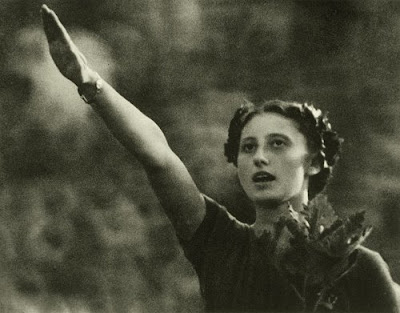
If I think of what images defines WW2 for me, it would be the contrast between the photos of destroyed towns and abandoned concentration camps filled with emaciated souls, taken by Allied photographers like Elizabeth Miller and Sam Gilbert, and the propaganda images of Hitler and the Nazi's taken by Leni Riefenstahl in Triumph of the will and Olympia. The difference between fanatic idealism and the harsh realities it left in its wake.

May the images made by those brave photographers remain in our minds. Let us never forget.

7 Nov 2008

The music of Ansel Adams

Many people don't realize that Ansel Adams started his life aiming to be a concert pianist and was gradually drawn away into photography driven by his passion for Yosemite valley.

The image above is the famous photograph of the Halfdome in Yosemite that marked a major turning point is his development as a photographer. He had spent the day climbing and taking pictures with his friends, it was close to the end of the day and he had only one glass plate left. With the convenience of our current technology it is easy to forget that men like Adams had to use large format camera with prepared glass plates to make their images. It was tiring and gruelling work to carry the large camera, heavy wooden tripod and the glass plates, especially if the photographer was climbing a mountain.

So he had only the one plate left and it was the end of the day and he had spent the day climbing with his gear. One can imagine that he was probably tired and ready to wrap things up. Up until this moment he had been struggling to make photographs that he felt lived up to the grandeur and beauty of the Yosemite. It suddenly occurred to him that he could really darken the sky if he placed a deep red filter over the lens. He exposed the glass plate and the result was this amazing image with the sky almost black and the massive rock face looming overhead. For the first time he had captured the sense of the imposing size and overwhelming presence of the Halfdome. It was the break through he had been looking for.

It is easy to assume that Ansel simply printed his Photograph from the negative and that he got it all exactly the way he wanted on the glass plate. But nothing is further from the truth. Ansel likened the process of making photos to his background in music. He often said that the negative is like the music score and in a symphony and that the development of the image in the dark room is the performance. People who witnessed the process said that it was like watching somebody doing a dance as he moved around in the darkroom in front of the enlarger dodging and burning the print. It would often take him a whole day of solid work before he found the right performance of the negative and was satisfied with a print.

Ansel spent a lot of time working at extracting from the negative what his mind's eye had seen when he exposed the glass.

Documentary versus Conceptual Photo art.

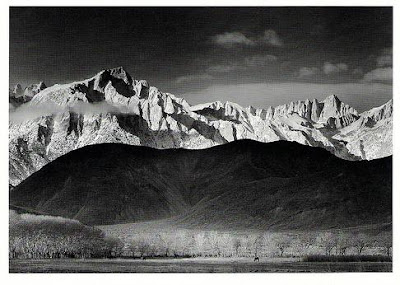
There seem to be a general division applied to photographic artists, you are either in the documentary or in the conceptual tradition. Generally speaking, documentary photographers are concerned with accurate and true representations of reality as they find it without modifications and embellishments. Conceptual photographers generally pre-visualize a concept which expressed in a photographic image that could be abstract, staged or heavily modified sometimes to the extent that the image is assembled from elements that does not even exist in reality. Now if I can narrow the discourse a little bit, in terms of art photography of landscapes, photographers like Ansel Adams (his famous image of the Tetons shown below) and other modern landscape artists of the kind that get published in the National Geographic are generally lumped with the documentary camp. It has a tradition that stretch back to the Photo Secession of Alfred Stieglitz.

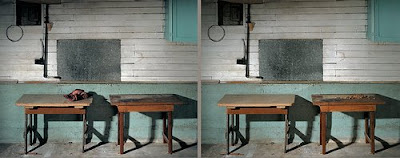
Artists like Anne Brigham and Jeff Wall (An octopus and some beans shown below) are in the conceptual artist camp. The tradition of conceptual photography really stretch back to the beginning of the medium in the successful struggle to gain recognition as a valid artist medium. It has really come into its own in the Post- Modern era and the fast majority of Art photographers who break into the big leagues today are conceptual artists. This is no accident, the whole art world is currently dominated by conceptual art.

The sad fact is that with the rise of conceptual art there has been growing a parallel disconnect with people who do not become to the artistic elite. The average person who views a piece of conceptual art is left, at best, feeling disconnected and unmoved by it, and often feeling that it is trivial junk that anybody could have done. Within the art community this is viewed as a barbaric perspective which speaks of a lack of culture and education and that if people would just educate themselves more they would see how profound it all is.

To me this is one of the saddest things that has happened in the art world. The self conscious superior artist who disdains the public they are dependant on and the public who has all but given up on art as anything useful to society. I recently had a member of one of the most famous Architectural firms in Vancouver tell me that he is yet to meet anyone in the general public who likes the buildings they design, and this is in spite of the fact that their reception is filled with Governor General medals and other honours. It is simply tragic for both sides.

I am hoping to move away from purely conceptual work and in my art create images of beauty that speaks to people in a direct way while giving the serious art aficionado something to chew on as well. Essentially, although my landscape work looks a lot like documentary work and I find much in the documentary tradition that appeals to me, it is more than an attempt to portray the world as it is. I am far to aware of my own subjective perspective to seriously believe in my own ability to objective portray anything. My work is therefore a conscious attempt to capture the emotional impression and the Genius Loci or spirit of the place that I find myself in. In this sense I have more in common with the conceptual tradition.

29 Mar 2008

Beauty and truth

The Vancouver art museum currently has an exhibition of the pictorialist photographers entitled "Truth and Beauty". I have spend the last few weeks slowly working my way through the very dense exhibition in small bits. I have also watched a PBS documentary on Alfred Stieglitz as a result of seeing the exhibition. I thought I would share some of my impressions from both of these. Stieglitz apparently said "photography is my passion, searching for truth my obsession" That resonates with me. What struck me most about his approach was that he moved beyond the obsession with the mechanism of making images and the emphasis on self conscious technical processes that dominated the late 19th century world of photography. It was a young medium and it seemed that most people were still stuck on the process. Stieglitz focused on the subject of his images and made beautiful images of beautiful things with the techniques to make them being a mere tool in the process of getting to what he wanted to express. It strikes me that we are currently again in a phase in photography where the technical mechanism has become more important than the subject with the advent of digital image making. I think we can learn some lessons from Stieglitz. Whether it is a digital negative and an electronic darkroom is secondary to the content of the image. Self conscious attempts to showcase the technical possibilities is merely that and will fade away quickly like all fads do. Making a memorable and lasting image has to touch something of the universal in the human condition and resonate with us on a much deeper and existential level. The second thing that struck me was the sheer beauty of contemplating the actual print. There is something mysterious in seeing a sheet of paper that was physically held by the photographers which we admire. The artifact is more than an image, it holds the memory and emotion of the artist in its fibers and slowly reveals it if we take the time. I fear that we are loosing something with electronic displays, their cold precision and their visual clutter. It struck me how dark most of the prints seemed in real life. I think that our perception of colour and light is shifting with illuminated displays on LCD and plasma screens. We are getting used to images that glow and shout at us with super realistic and intense colour. We consume these images like fast-food without even tasting what we consume, flipping from one to the next with utter ease and barely looking at what we see. When we look at a print it can seem flat and dark in comparison. But we are mistaken, there is a subtlety in the printed photo which is difficult to describe, in the same way that a good bottle of wine or single malt has a subtlety that it reveals only to the educated palate. It does not shout, it whispers, it is about quality instead of quantity, about craftsmanship and passion and taking time to create something that reveals beauty and meaning. It is subtle and refined and it demands that we slow down, contemplate it and absorb it. When we do it has the power to inspire, uplift and change us.